
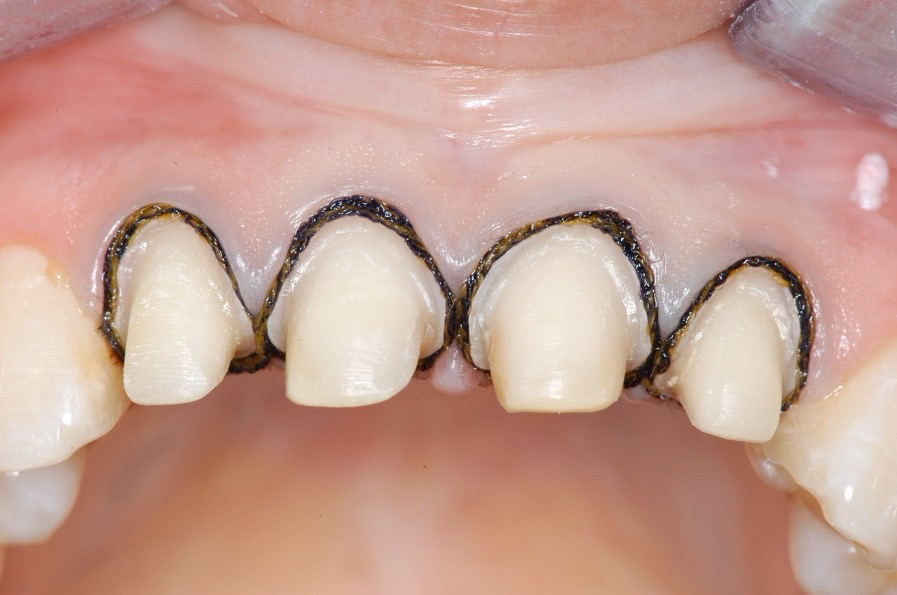
Sometimes the smallest space around a preparation determines the success of the entire restoration.
Capturing a well defined restorative margin requires more than an accurate impression material. The clinician must create an environment in which that material can reach the margin, reproduce its details, and remain undisturbed while doing so.
That makes gingival tissue management one of the most important, and sometimes underestimated, steps in the impression procedure.
Controlled displacement, not force
The objective seems straightforward: temporarily displace the gingival tissue sufficiently to expose the preparation margin. Clinically, however, there is an important balance. Too little displacement can leave portions of the margin inaccessible. Too much manipulation can traumatize the tissues, produce bleeding, and make the impression more difficult rather than easier.
The technique illustrated here uses retraction cord positioned carefully around the prepared teeth. The important concept is controlled displacement rather than forceful retraction. The cord should create the necessary space while respecting the surrounding tissues.
Cord selection matters as well. A cord that is too large may require excessive pressure during placement. One that is too small may fail to produce adequate displacement. The sulcus, the location of the restorative margin, and the amount of displacement required should guide the approach.
Moisture can undo excellent preparation
A margin may appear clinically visible and still be surrounded by enough crevicular fluid or blood to compromise reproduction of fine detail. Proceeding too quickly can produce an impression that looks acceptable initially but contains an indistinct or incomplete margin.
That creates a frustrating sequence: an inadequate impression can lead to uncertainty at the laboratory stage, additional adjustments, or repetition of the procedure. The better approach is to solve the problem before taking the impression.
Careful tissue displacement, appropriate moisture control, and inspection of the margins allow the impression material to perform as intended. Just as importantly, atraumatic technique helps the tissues recover after the procedure rather than turning tissue management itself into a source of inflammation or injury.
The practical lesson
The best impression material cannot compensate for inadequate access to the restorative margin. Successful impressions depend on a sequence of small clinical decisions: appropriate cord selection, controlled placement, adequate displacement, moisture and bleeding control, and careful inspection before proceeding.
When those steps are performed correctly, tissue management becomes almost invisible in the final restoration. And that is precisely the point.
This educational summary is based on our previously published clinical work and the literature supporting the technique.
Explore Publications on ResearchGate