
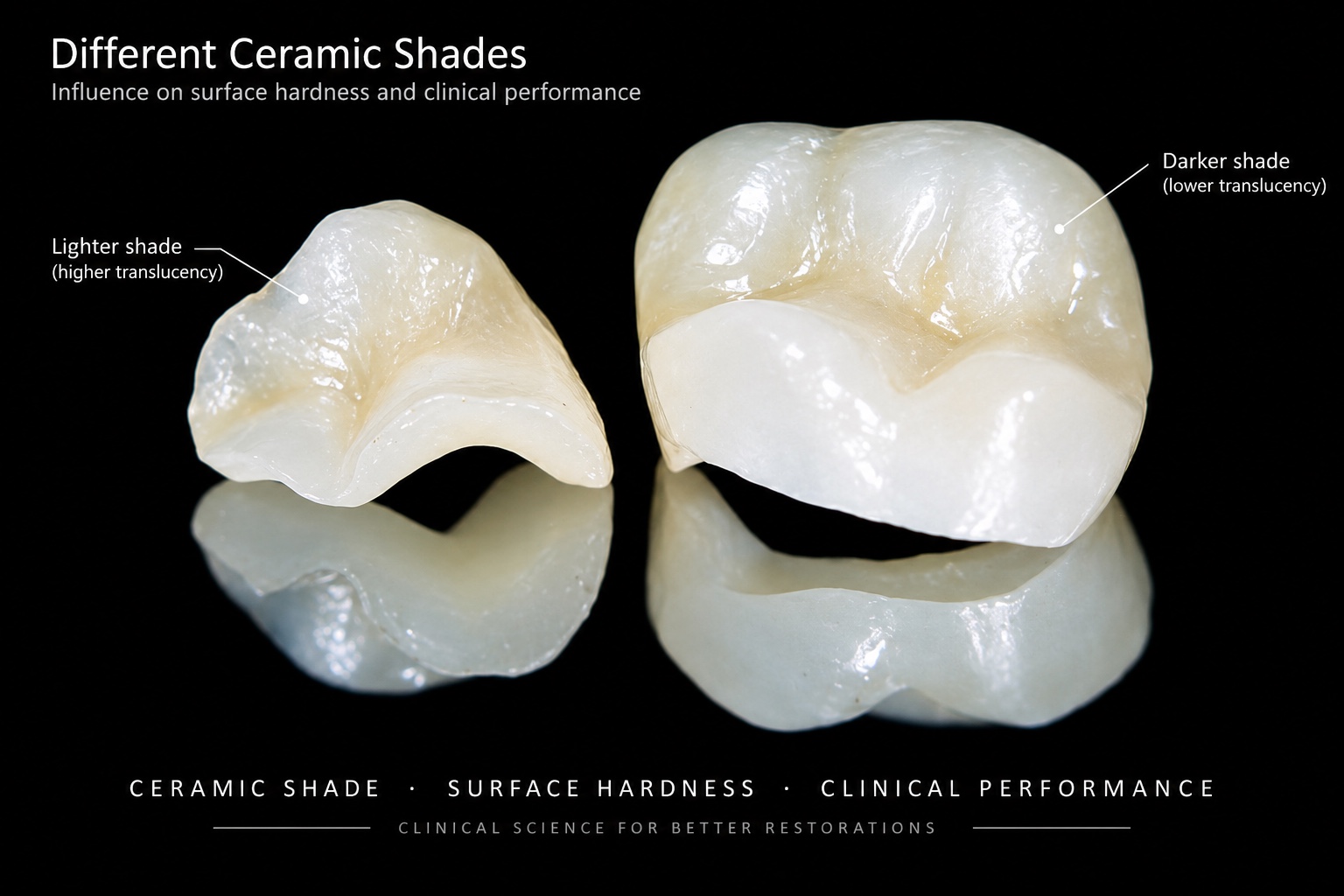
Twelve years is long enough for a restoration to tell us much more than whether it looked good on the day it was placed.
Ceramic inlays and onlays offer an attractive option for restoring posterior teeth when esthetics, preservation of tooth structure, and adhesive techniques are important. The more meaningful question is what happens after years of function.
Our clinical study followed ceramic inlays and onlays for 12 years to observe how they performed over time. Eighty six restorations were placed in 35 patients using two ceramic systems. The restorations were adhesively luted under rubber dam and evaluated at baseline and after 1, 2, 3, 5, and 12 years using modified USPHS criteria.
The story changed with time
The early results were encouraging. At the five year recall, the study recorded an overall success rate of 87 percent. By the 12 year recall, 22 patients with 48 restorations remained available for evaluation. Seven restorations had fractured, eight presented secondary caries, and nine showed unacceptable marginal defects requiring repair or replacement. Four IPS Empress restorations also presented pulp sensitivity.
Those findings matter because they remind us that long term restorative success is not defined only by whether the ceramic itself fractures. Recurrent caries and deterioration of marginal integrity also became important reasons for failure.
Failure is not always about the ceramic
A ceramic restoration does not function independently. Its long term performance also depends on the preparation, adhesive procedures, luting material, margins, surrounding tooth structure, and what happens to those interfaces after years of exposure to the oral environment.
The study observed significant changes over 12 years in color match, surface texture, marginal discoloration, and marginal integrity for both ceramic systems. A restoration that remains intact is therefore not necessarily unchanged.
How much tooth do we really need to remove?
The longevity observed in this study raises a broader restorative question: when sufficient healthy tooth structure remains, is complete coverage always necessary?
A full crown has an important and well established place in restorative dentistry, and there are situations in which complete coverage is appropriate. At the same time, preparing a tooth for a crown requires removal of tooth structure that might otherwise be preserved.
Gordon Christensen has discussed this issue in the restorative literature, encouraging clinicians to consider onlays when the clinical situation permits a more conservative partial coverage approach. More recent systematic reviews have also examined partial coverage restorations as alternatives to full crowns. The evidence does not justify declaring one approach universally superior, but it supports a thoughtful discussion about preservation of sound tooth structure.
The useful question is therefore not whether onlays are better than crowns. It is: how much sound tooth structure must we sacrifice to achieve a durable restoration?
The principle is preservation, not avoidance of crowns
The message is not that clinicians should stop placing crowns. It is that sound tooth structure has value. When sufficient structure remains and the clinical conditions permit a partial coverage restoration, preservation deserves consideration alongside strength, esthetics, material selection, adhesive requirements, and expected longevity.
The practical lesson
Think beyond the ceramic. Long term success involves the restoration, the adhesive interface, the margins, the remaining tooth structure, and continued clinical monitoring.
Sometimes the most important information about a restoration appears not when we place it, but when we have the opportunity to see it again many years later.
Santos MJMC, Freitas MC, Azevedo LM, Santos GC Jr, Navarro MFL, Francischone CE, Mondelli RFL. Clinical evaluation of ceramic inlays and onlays fabricated with two systems: 12 year follow up. Clinical Oral Investigations. 2016;20:1683–1690.
View Publication on ResearchGateExplore Our PublicationsAdditional reading: Gordon Christensen's discussion of onlays versus tooth colored crowns and contemporary systematic reviews comparing partial and complete coverage restorations provide context for the preservation discussion above.