
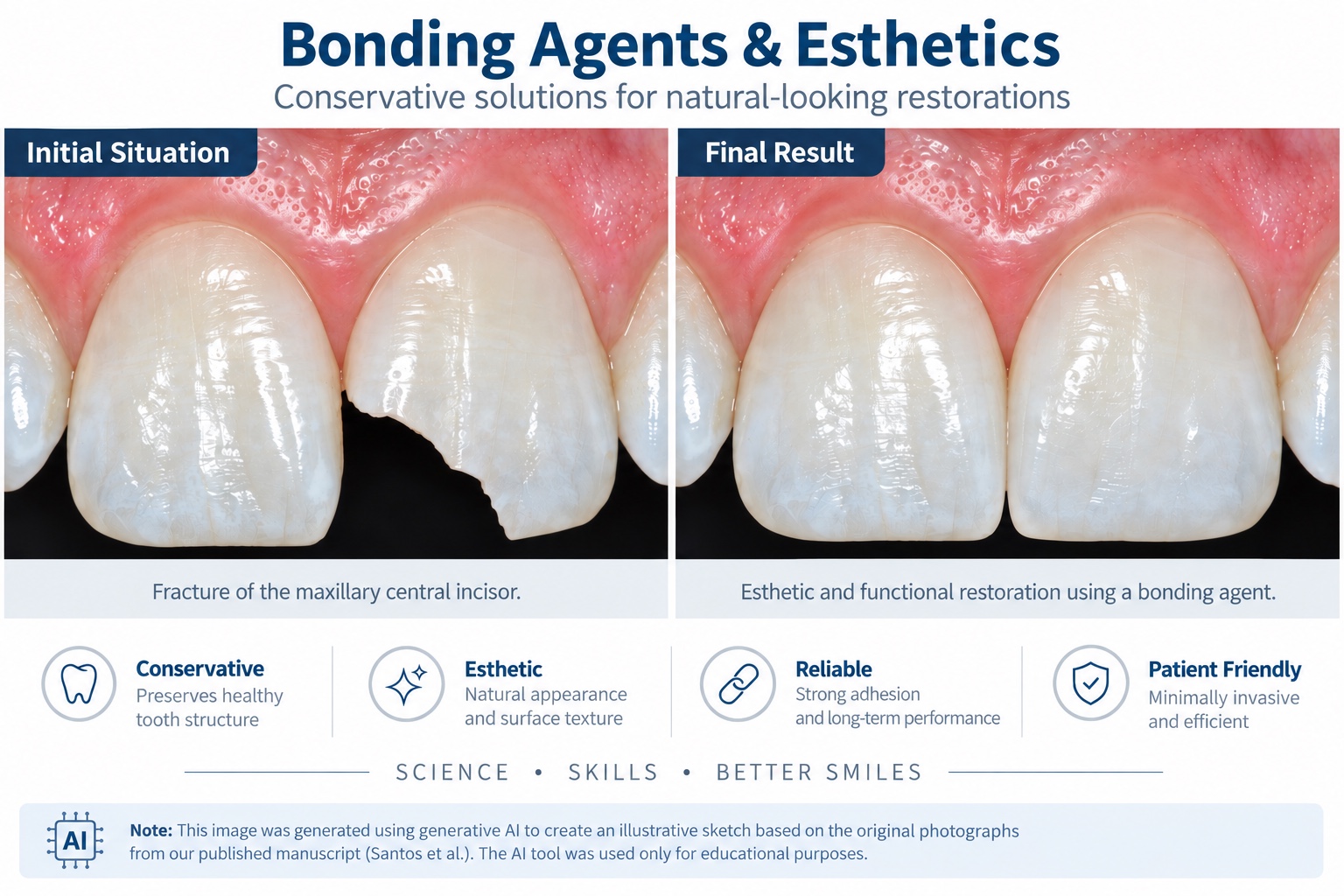
A fractured anterior tooth presents a small defect with a very large esthetic challenge.
The clinical situation immediately illustrates the problem. Tooth structure has been lost from a maxillary central incisor in an area where even minor discrepancies in contour, shade, translucency, and surface texture can become readily visible.
The challenge is not simply to replace what is missing. It is to restore the tooth conservatively while making the restoration visually integrate with the remaining natural structure.
Conservative does not mean simple
Adhesive dentistry makes conservative treatment possible because retention does not always need to depend primarily on extensive mechanical preparation. When appropriate, preservation of sound tooth structure can become part of the restorative strategy.
But the quality of the adhesive procedure depends on a sequence of steps, and seemingly minor errors can affect the final result. Isolation is critical. The adhesive protocol must be followed carefully, including appropriate surface treatment, application of the bonding agent, solvent evaporation when required, and adequate light activation.
Where problems occur
Many esthetic failures originate from small compromises accumulated throughout the procedure: inadequate isolation, errors during adhesive application, inappropriate material thickness, incorrect contour, insufficient finishing, or excessive removal of sound tooth structure.
There is also a much more basic step that can easily be overlooked: cleaning the tooth before bonding.
Remember your days in dental school, when cleaning the preparation before placing the restoration was a fundamental step? That principle did not disappear when adhesive systems became more sophisticated.
Biofilm and debris left on the tooth surface can interfere with the adhesive procedure. Trapping contamination beneath the restoration may also contribute to problems at the adhesive interface. Over time, marginal leakage and staining can compromise an otherwise well executed esthetic restoration.
Modern bonding agents are sophisticated materials, but they cannot compensate for poor surface preparation. A predictable adhesive procedure still begins with a clean substrate.
Recreating the tooth, not simply filling the space
Replacing missing tooth structure involves more than placing composite into a defect. Proximal contour, incisal anatomy, facial curvature, translucency, and the transition between restorative material and natural tooth all influence whether the restoration becomes visually integrated or remains detectable.
Finishing and polishing are therefore part of the restorative process, not merely cosmetic steps at the end. Subtle reproduction of natural contours and surface characteristics can significantly improve optical integration.
The practical lesson
Successful anterior bonding sits at the intersection of science and clinical artistry. Preserve what is healthy. Clean and prepare the substrate properly. Use adhesion intelligently. Recreate form deliberately. Then finish the restoration so that material and tooth function visually as a single structure.
The goal is not simply to repair the fracture. It is to make the repair increasingly difficult to notice.
This educational summary revisits concepts from our published clinical article and translates them into a contemporary professional discussion.
Explore Publications on ResearchGate